 An official website of the Cuyahoga County government. Here’s how you know



Paramedic/EMT
Average Pay: $46,350/year or $22.28/hour
Education: High School Diploma/GED and postsecondary instruction/certification
Work Location: On-site and in the field
What is a Paramedic/EMT
Emergency medical technicians (EMTs) and paramedics assess injuries and illnesses, provide emergency medical care, and may transport patients to medical facilities. You begin as an EMT and advance to a Paramedic.
Basic Duties
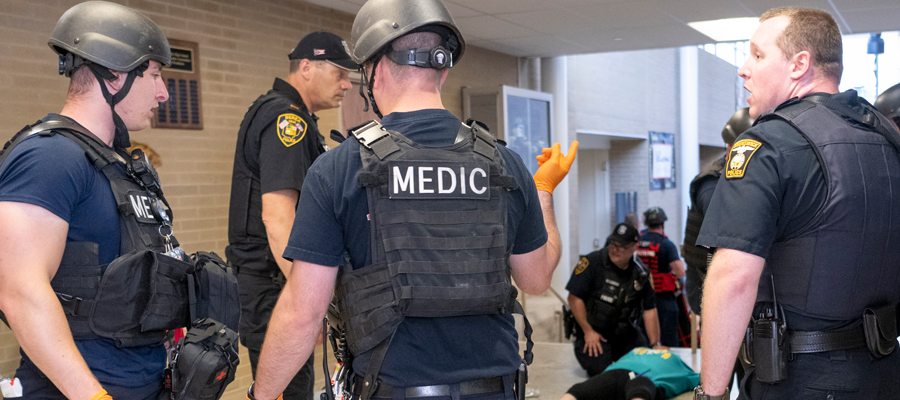
EMTs care for patients at the scene of an incident and while taking patients by ambulance to a hospital. An EMT has the skills to assess a patient’s condition and to manage health emergencies and trauma incidents.
Paramedics provide more extensive prehospital care than do EMTs. They are able to administer a wider range of medications, perform advanced airflow management and interpret electrocardiograms (EKGs) and other types of equipment.
Both typically interact with other public safety and support personnel and often work alongside police and firefighters.
Hiring Roadmap
Typical Entry-Level Requirements
- Must be at least 18 years old.
- Have a valid driver’s license.
- A high school diploma or equivalent.
- CPR and basic life support (BLS) certification.
- Complete EMT-Basic certification training (typically takes about 1 year) and pass the state/national test.
- Complete Physical Agility Test (PAT). Locally offered at Tri-C or Auburn Career Center. Check with the department to see who they accept PAT from.
- Complete NREMT (National Registry of Emergency Medical Technician) examination.
- Apply to take civil service test - each department has their own schedules for testing.
- Additional interviews and evaluations may occur such as medical evaluation, criminal history/background check, and psychological evaluation.
Training
Programs are offered by technical institutes, community colleges, universities, and facilities that specialize in emergency care training. Some instruction may take place in a hospital or ambulance setting.
Additional instruction is necessary for advanced skills, such as using complex airway devices, intravenous fluids, and some medications.
Continuing education is required to maintain these credentials.
With additional education, paramedics may transfer into other healthcare occupations. For example, paramedic-to-RN programs offer an accelerated pathway to becoming a registered nurse.
Average Pay & Benefits
National median average per US Bureau of Labor Statistics: $46,350 per year or $22.28 per hour.
Benefits will vary, full-time employees often receive medical, dental, vision, paid time off, holiday pay, overtime pay, uniform allowance, retirement/pension plan.
Work Environment
Work both indoors and outdoors, in all types of weather. The work is physically strenuous with much of the time standing or moving. This work also may be stressful, especially when it involves life-or-death situations.
Most EMTs and paramedics work full time and typically work 12-, 18-, or 24-hour shifts, and include nights, weekends, and holidays.
Where Can You Work
There are 52 fire departments and 1 standalone EMS department (Cleveland EMS) in Cuyahoga County. You can search department openings here.
WHY CHOOSE A CAREER IN PUBLIC SAFETY
Because they are in HIGH DEMAND.
Due to ongoing needs for public protection, emergency response, and legal services there are many opportunities available within in the career field of public safety.
Job Opportunities at Cuyahoga County Local Municipality Job Listings See List of Local Agencies Public Service Career FAQs